


👋 Hi and welcome to today’s edition of Venture Radar - where we uncover real internet businesses making real money, and break down how they do it.
In today’s write-up, we’re sharing curated articles, posts, videos and business we found interesting on building boring and underrated businesses.
Steal these ideas: From IVF insurance to AI agent trust score - 3 billion dollar ideas.
From reddit: $224K profitable business, $28/year ElevenLabs alternative & $40K/year renting business
Businesses: $120K–$300K/year from niche sports content & $25K+/month from a prayer app.
🗃️ CURATED RESOURCES FOR FOUNDERS
The founder’s guide to building in public (20+ real examples)

A practical playbook for growing your startup by sharing progress publicly. Learn what to share, where to post, how often to show up, and study 20+ real founders doing it right. Includes templates and prompts in a Notion-based pack. (Get Access Here)
Marketing for founders: a practical playbook to get users

A no-fluff guide for founders who want users without ads or agencies.
Covers distribution, outreach, messaging, SEO, and demand testing — all solo-founder friendly. Delivered as a Notion-based resource you can use immediately. (Get Access Here)
🤝 Partner with us..
Get your brand in front of 40000+ readers including founders, indie hackers, operators and aspiring founders. Partner with us →
🥷 STEAL THIS BUSINESS IDEA
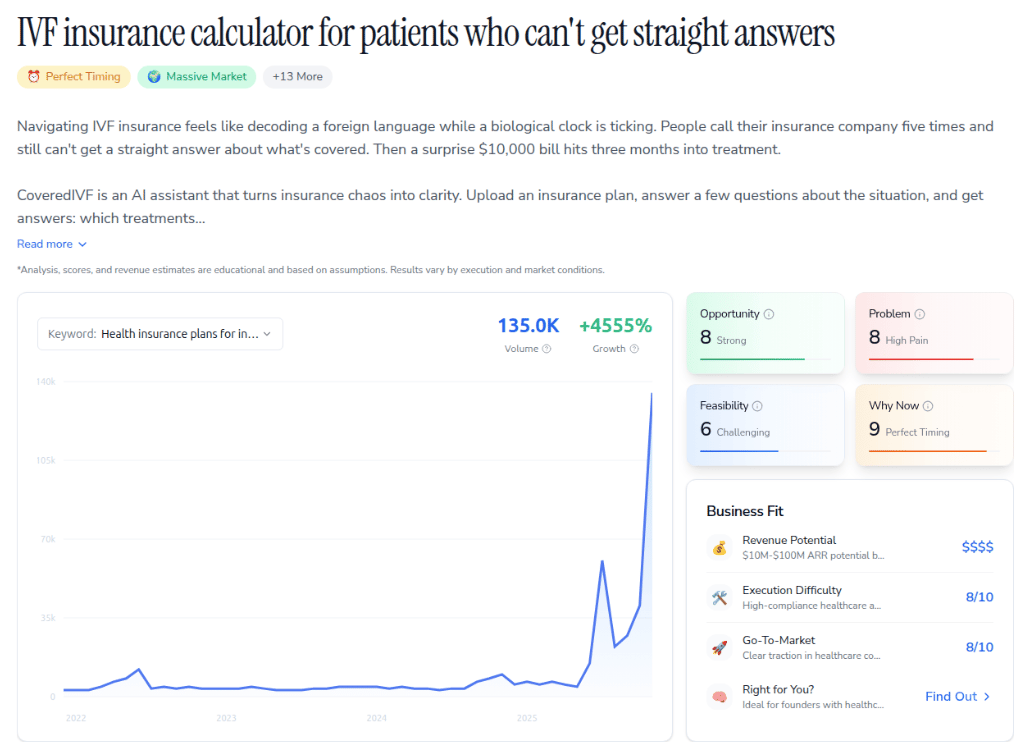
IVF Insurance Calculator
Until I came across this idea, I didn’t even know IVF insurance issues were a thing.
But I’d imagine that for the people undergoing the 432,000 IVF cycles that are completed in the US per year, they know it very well.
Turns out it isn’t very clear what’s covered by insurance, how much will be, etc. Basic questions.
A simple idea to help with this would be a calculator that understands and can correctly interpret various plans to let people know what to expect.
That part should be free, but then you can monetize by taking commissions on cases where they want to change their insurance to ensure they are covered.
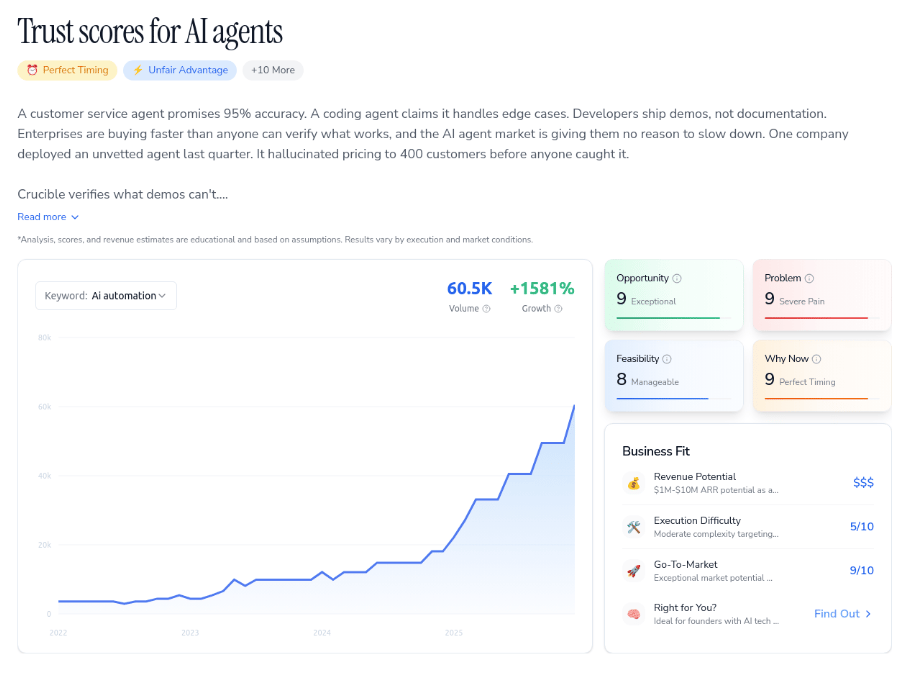
AI Agent Trust Scores.
As the world gets more complex, change accelerates.
I know I’m not the only one who feels like every day I’m heads down on my business, I miss at least one major AI-related update.
This is how it feels during times of massive disruptive change.
But no one has time to keep up with it all.
Trust scores for agents, based on some centralized standard, rating them on qualities like how often they hallucinate, how much the actual functionality matches the marketing, and the quality of their outputs would be a valuable certification-style business to set up.
AI Permitting-as-a-Service
You think the DMV is slow? Try getting a building permit approved in San Francisco.

It’s a nightmare of outdated systems, paperwork, delays, and human bottlenecks often taking months to process basic approvals.
The solution is obvious: an AI-powered permitting assistant.
Reads zoning/code data
Auto-generates documentation
Flags violations instantly
Prepares filings across cities/counties
But the real challenge isn’t tech. It’s sales.
Convincing government agencies to adopt anything new let alone AI is the moat.
That’s the opportunity:
Build with early adopters (small towns, private permit expeditors)
Prove faster processing + fewer mistakes
Use that wedge to expand city by city
Once inside, you become the default infrastructure.
Feels like OpenGov for the AI era slow to start, massive once embedded.
$224K profit flipping number plates using a Python scraper
From a Reddit post by u/TheTeflonDan who used data scraping to find underpriced collectible license plates in Australia:
In Australia, heritage number plates issued in the early 1900s have become collectibles
Plates with patterns, repeating digits, round numbers, or sequences can sell for huge premiums

How he found deals:
Hired a freelance developer to scrape the VicRoads database (285K+ plates)
Cross-referenced government asking prices with recent secondary market sales
Used the data to identify underpriced plates with high resale value
Some of his flips:
Bought 9 plates for $12K each ($108K total) → sold for $304K
Profit: $196K
Best flip: plate 142.000
Bought: $12K
Sold: $50.1K
Return: 318%
Quick flip: plate 234.345
Bought: $30K
Sold: $43K in under a month
Then a market catalyst hit:
VicRoads stopped issuing heritage plates, making the resale market the only source
Scarcity pushed prices higher
Current position:
Holding 10 plates purchased for $198K
Expects to sell them for ~$30K each
Overall numbers:
Total capital deployed: $507K AUD
Realised profit so far: $224K+
The bigger lesson:
This isn’t really about number plates
It’s about data arbitrage
Use scrapers to scan large public datasets and find underpriced assets.
This approach could work for:
Domain names
Vintage collectibles
Trading cards
Marketplace listings
Real estate deals
He built a $28/year ElevenLabs alternative in 2 days.
From a Reddit post where a developer built a DIY voice cloning tool after getting frustrated with expensive AI subscriptions:

He was paying $22/month for ElevenLabs but kept hitting the 1h 30m voice limit while generating YouTube scripts
So he tried a different approach: subscribed to GLM 4.7 (a Chinese LLM) for $28/year and started building his own tool
How he built it:
Used GLM 4.7 for about 90% of the code
Used Claude Opus only when the voice cloning logic got tricky
Built a simple offline Windows app in just 2 days
What the tool looks like:
Portable Python app — just unzip and run a
.batfileNo website, installer, or fancy UI
A basic GUI that runs completely offline
Why people like it:
Generates unlimited voiceovers
No usage credits or dashboards to worry about
Costs almost nothing compared to subscription AI tools
Early traction:
Listed it on Gumroad
Got 2 sales in the first 24 hours, already covering the cost of the GLM subscription
The bigger insight:
The gap between cheap open-source AI tools and expensive SaaS AI products is shrinking fast
Many developers are now “vibe coding” small utilities like screen recorders, debloaters, and audio tools
Takeaway: If you’re paying $20+/month for an AI tool, there’s a good chance a DIY version could be built in a weekend and sold cheaply on platforms like Gumroad.
$40K/year renting tables & chairs for events
From a Reddit post on r/sidehustle where someone shared how they built a small event rental business:

Started in June 2024 after watching videos from TheRentalGuy on YouTube
Created an LLC, logo, and Facebook Marketplace listings for table and chair rentals
Initial inventory idea:
White padded folding chairs
Round and rectangular tables
The crazy start:
Posted listings at 8:00pm on a Friday
By 8:30pm, got a booking for a 300-person party — even though he owned nothing yet
Took a 50% cash deposit, then used it to help fund $10K worth of equipment
Revenue so far:
Aug–Dec 2024: about $8K revenue
First full year projection: around $40K
Typical weekend income:
Small bookings: ~$200
Large events: up to $3K
How the business runs:
Busy season: March–October
Operates out of a 16×22 garage + enclosed trailer
Main downside:
Cleaning chairs after rentals (about half the time)
Why it works:
Once equipment is paid off, margins improve significantly
Some jobs bring $500+ for just a couple hours of work
Takeaway: Even with a small inventory, event rentals can become a solid local side hustle, especially during wedding and party season.
🗃️ SIDE HUSTLES & BUSINESSES
$25K+/month from a prayer app built in just 3 days
Mau Baron built PrayerLock, a simple Christian app that locks your phone until you complete a prayer session. The idea is extremely straightforward, remove distractions and encourage users to spend one minute in prayer. Despite the simplicity, the app has taken off.

Built in just 3 days using AI tools (Mau isn’t a developer)
Now has 13,000+ App Store reviews with a 4.9 rating
Generates $25K+/month in subscription revenue
Bootstrapped and built for a very specific community: Christians looking to build prayer habits
Mau says the turning point came when he stopped chasing content traction and spent months focusing purely on building a product. By the time he returned online, the app was already making $20K/month.
The bigger lesson: simple utility apps for passionate communities can be huge businesses. Religious audiences, hobbyists, fitness groups, students, if you solve a small but meaningful problem, subscriptions can compound quickly.
From a $15/hour job to $50K/month hauling junk
Matt, founder of Sonoma Strong Hauling, started his junk removal business at one of the lowest points in his life, fresh out of prison and rehab, working a $15/hour deli job at Safeway. All he wanted was an extra $2,000/month. So he started hauling junk with a beat-up pickup truck.
First customer came from a free Craigslist post
Early marketing was simple: candy dishes + business cards dropped at local real estate offices
Realtors became his biggest referral source for estate cleanouts, move-outs, and hoarder houses
Started as a side hustle while working nights at Safeway
Today the business brings in $50,000/month in revenue with about 35% profit margins.
The insight: simple service businesses often grow fastest when you tap into existing referral ecosystems. In this case, realtors constantly need reliable junk removal — and once Matt became their go-to guy, the jobs kept coming.
$5K/month selling code to the people copying his startup
Piotr Kulpinski built OpenAlternative, a directory of open-source software alternatives that quickly gained traction, hitting 100K visitors in its first week and eventually reaching $6.5K/month in revenue. But success came with a problem: people kept cloning his site.
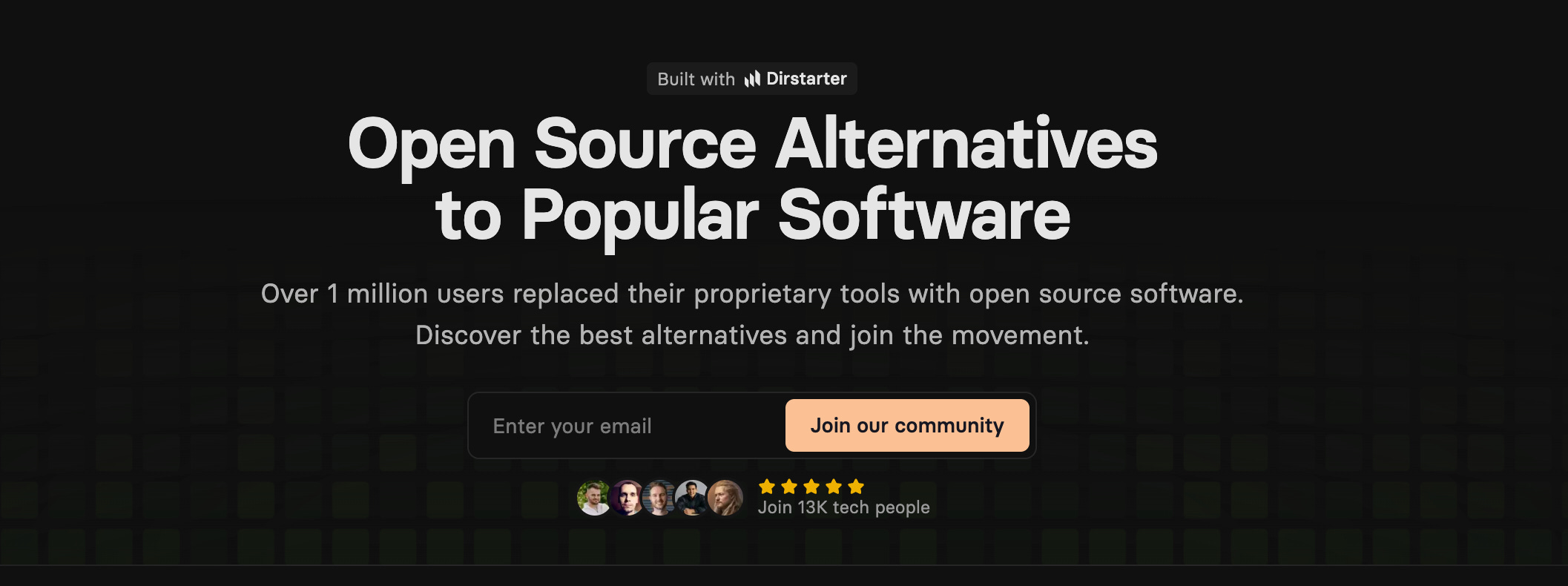
Instead of fighting the copycats, Piotr turned them into customers.
Packaged the site’s code into a directory boilerplate called Dirstarter
Pricing: $159 (Standard) and $199 (Pro)
Built the MVP in just one week
183 customers so far, generating ~$5K/month
Interestingly, most marketing channels didn’t work - Reddit posts, paid placements, and directories flopped. The two channels that did work were:
SEO
Affiliates (30% commission)
The insight: when your project keeps getting cloned, it’s a signal. Instead of trying to protect the idea, productize the thing people want to copy and sell it to them.
$120K–$300K/year from niche sports content
A deep dive into golf content creators shows just how lucrative niche sports media can be. Creators with a few hundred thousand followers are already earning six figures through brand deals, YouTube ads, and partnerships.

Creator with 400K followers: ~$120K/year, brand deals typically $800–$5K per post
Creator with 500K followers: ~$225K–$250K/year, up to $300K with YouTube AdSense
Full-time threshold: roughly 100K Instagram followers or 50K YouTube subscribers
Emma Carpenter, with ~89K Instagram followers, already supports herself through creator income and says the money easily beats entry-level broadcasting jobs.
One surprising insight: the highest-paying sponsors often aren’t sports brands. Industries like alcohol, gambling, and automotive companies have much larger marketing budgets.
The playbook is simple:
Pick a sport → share coaching tips, training routines, and insights → grow an audience → monetize with sponsors and ads.
🤝 Partnership With US
Partner with us : Get your brand in front of 40000+ readers including founders, indie hackers, side hustlers and aspiring founders.
Thanks for reading today’s newsletter. Stay tuned for more!