


👋 Hi and welcome to today’s edition of Venture Radar - where we uncover real internet businesses making real money, and break down how they do it.
Steal these ideas: From niche escrow platform to AI house manager.
From reddit: $200K ARR cloning existing apps & underrated business ideas.
Businesses & Side Hustles: million dollar sticker business from home and AI building $117k business.
🚀 Don’t miss this opportunity: Venture Radar Premium is now live…
Over the last few days, many readers have already joined Venture Radar Premium - and we’re just getting started.
We built this for founders, indie hackers, operators, and curious builders who want deeper research on profitable internet businesses most people ignore.
As a premium subscriber, you’ll get:
2–3 premium deep dives every week
Detailed breakdowns of underrated businesses, revenue models, growth strategies, and distribution tactics
Founder playbooks, guides, and practical templates
A growing database of profitable business ideas updated every week
Private Substack Chat community with other builders
And this is only the beginning.
🎉 Special launch offer: Get 25% off forever if you join within the next 5 days.
If you’ve enjoyed Venture Radar so far, Premium was built to give you the deeper insights, research, and practical resources we couldn’t fit into the free edition.
This is the next evolution of Venture Radar and we’re excited to build it with you.
Partner with us..
Get your brand in front of 50000+ readers including founders, indie hackers, operators and aspiring founders. Partner with us →
🥷 STEAL THIS BUSINESS IDEA
Escrow platform for authors & freelancers
Ever tried publishing a book?
A few friends have, and there are really two worlds:
When you land a deal with a big publisher, they help you out with an advance that gives you flexibility and freedom to explore and write what you want.
When you self-publish, you’re paying upfront and hoping for a payoff on the backend.
The problem is that sometimes those payments (for anything from cover design to ghostwriting to editing) don’t work out. And when it comes out of your own pocket, that can make or break the project.
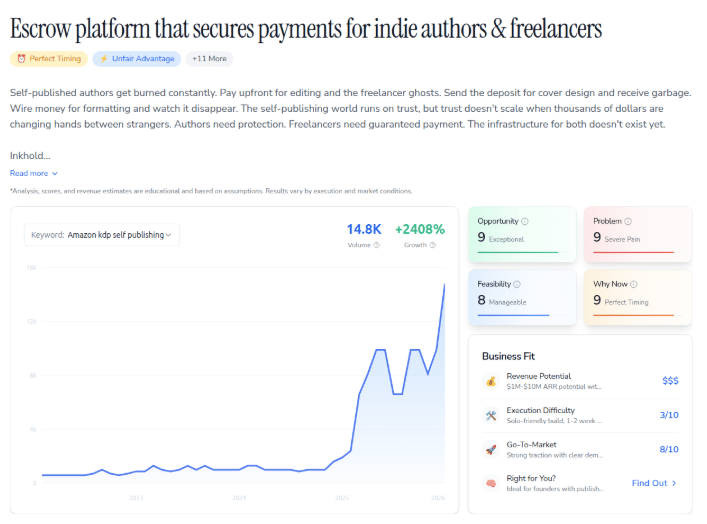
Authors need to be protected in these scenarios. But the freelancers working for them need guaranteed payment.
Platforms like Upwork offer escrow options but have terms that tend to be less than friendly to one or both parties, and using them requires finding the freelancers there in the first place.
There’s an opportunity for a lightweight escrow platform that could, eventually, expand to other niches, but by starting specifically with self-publishing.
Traditional escrow platforms aren’t really set up for self-publishers either. Publishing and creative projects have specific milestones and workflows (unlike using an escrow platform for something like selling a used car), and you could also build in things like IP protection and dispute resolution that’s unique to the industry as well.
Perfect course finder
Maybe a hot take but I believe someone can learn more relevant information for navigating the world today from online courses than a traditional college education.
Unfortunately, there’s also a lot of low quality courses out there.
And there’s no easy way to find the right one for you when you want to learn something specific.
But LLMs can solve this.
A service that talks to you about what you want to learn, understands your request in detail, and then scours the internet to find the most up to date and well regarded course on it.
It would increase course completion rates and, more importantly, help people learn more of what they’re curious about.

FROM OUR PARTNER - DOFOLLOW
🔎 Invisible in Google and AI search? Your buyers may never find you.

Your buyers aren’t relying on Google alone anymore. They’re asking ChatGPT, Gemini, and Perplexity which vendors are worth evaluating.
If your brand isn’t consistently mentioned across trusted websites, you risk losing visibility before the sales process even begins.
dofollow.com helps B2B SaaS companies build the authority that drives visibility across both traditional search and AI-generated answers. They secure high-authority backlinks and branded mentions on publications that influence rankings, recommendations, and buyer trust.
The result is simple: stronger visibility, more qualified traffic, and more demos.
Trusted by companies like Pitch, Surfshark, and LegalZoom, dofollow helps SaaS brands show up where modern buyers are searching.
See how dofollow helps B2B SaaS companies win visibility →
🏇 REDDIT - SIDE HUSTLES & BUSINESS
$200K ARR cloning existing apps and undercutting on price
From a Reddit post where a developer shared a blunt, no-BS strategy to build SaaS without chasing “unique ideas.”
Instead of trying to invent something new, he looks for apps that are already making money, clones them using AI, improves a few things, and charges significantly less.

Strategy:
Find proven apps
Rebuild with AI (faster + cheaper)
Improve slightly
Undercut pricing
His edge comes from geography. Living in the Philippines means lower costs, so he can profitably charge $5/month for something competitors in the US or Europe price at $20–30.
Built 2 apps so far:
GLP-1 medication tracker (dose tracking, reminders, progress)
Workout logger (focused on progressive overload)
Workout app drives ~70% of total revenue
He claims ~$4K/month across both apps (no proof shared), but multiple commenters say they’re seeing similar results using the same approach.
The real unlock is speed.
Uses Claude Code to build apps 10x faster than traditional dev
Focuses on shipping quickly instead of perfecting features
Iterates based on user feedback
His thinking is simple: most categories already have demand, but many products are overpriced or outdated. That gap is enough.
Target niches where:
Users already pay
Existing tools feel expensive or clunky
You understand the problem personally
Now he’s hiring locally to scale this into 4–5 apps, aiming for $100K–$200K ARR.
The takeaway: originality is overrated. In many cases, execution speed + pricing + distribution beats building something new from scratch.
Accidental $10K/year hustle flipping facebook marketplace finds
From a Reddit post where someone stumbled into flipping furniture - not by planning a business, but out of boredom one night.
At 11pm, they were scrolling Facebook Marketplace and saw a solid wood dresser listed for $25 because it was “too heavy to move.” They had a truck, picked it up the next day, cleaned it, tightened a few handles, took better photos — and sold it for $140 within two days.
That one flip changed how they saw everything.
Bought for $25 → sold for $140
No real “work” — just cleaning, minor fixes, and better photos
Since then, it turned into a habit more than a business.
Constantly scanning Marketplace during random moments
Spotting underpriced items instantly
Garage slowly filling with “temporary” inventory
Always carrying something in the car to flip next
They started seeing opportunity everywhere — chairs, lamps, shelves, lawn tools — anything underpriced that could be cleaned up and relisted.
The interesting part isn’t the money (though it adds up). It’s the mindset shift.
Once you understand pricing gaps, you can’t unsee them. Every garage sale, curbside item, or lazy listing becomes a potential flip.
The takeaway: many side hustles don’t start with strategy — they start with one small win that rewires how you see everyday opportunities.
$300-400/day renting refrigerated trailers to businesses in emergencies
From a Reddit post on sharing a niche “boring business” that quietly prints money.
The idea is simple: rent out mobile refrigerated trailers - basically insulated trailers with built-in cooling systems that can function as a fridge or freezer. These units are used when businesses suddenly lose cold storage or need temporary capacity.
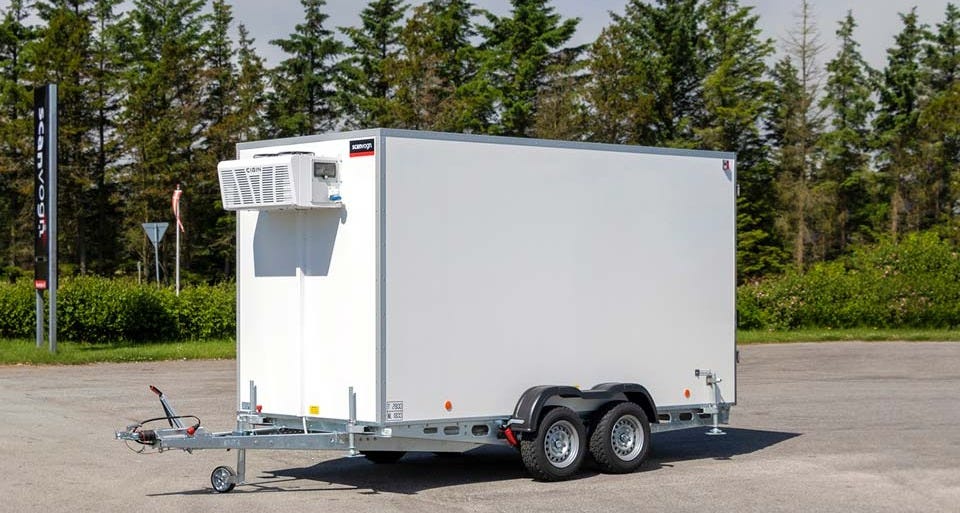
Startup cost: ~$25K–$45K per trailer
Typical size: 12–16 ft enclosed trailers with freezer units
What makes this business interesting is when demand shows up. Most rentals happen during emergencies, a restaurant’s walk-in freezer breaks, a hospital needs backup storage, or an event has no cold setup.
Customers include: restaurants, schools, hospitals, florists, caterers, military, disaster relief teams
Use cases:
• equipment failure → prevent inventory loss
• large events → temporary cold storage
• disaster situations → food, water, medical storage
Because it’s urgent, customers don’t spend time comparing prices. They just need a solution fast.
That urgency drives strong unit economics:
Typical pricing: $300–$400/day
Many rentals last days, weeks, or even months
Example: military renting units for 8–12 months
The business is also operationally simple. No heavy labor, no complex systems.
Customer acquisition: website + Google Ads + Google Business listing
Low competition compared to common rental businesses like tents or party equipment
The real upside comes from long-term rentals. Once a unit is placed, it can generate passive income for weeks with minimal involvement.
The insight here is classic: boring, overlooked problems, especially urgent ones often hide the best business opportunities.
🚀 Unlock Venture Radar Premium
Subscribe to Venture Radar Premium for deeper research on profitable underrated internet businesses, with access to premium deep dives, practical playbooks, business idea databases, templates, and a private community of founders and builders.
🗃️ REAL BUSINESSES
$250K/year selling stickers from a home setup
Therese Waechter turned a simple sticker idea into a $250K/year e-commerce business (Otto’s Grotto). What started as a side experiment during the pandemic evolved into a multi-platform machine across Etsy, Amazon, Faire, and Shopify.

Started on Facebook Marketplace, hitting ~200 orders/day at peak
Shifted from print-on-demand → in-house production for better margins
Now sells across 4 channels:
Etsy (30%)
Amazon FBA (30%)
Faire wholesale (30%)
Shopify (10%)
Runs from home setup: print → laminate → cut workflow
Moving toward outsourced production for semi-passive income
Her biggest unlock: Each platform works differently and she treated them that way.
Amazon → optimize for sales velocity (ads early, then organic)
Etsy → constant discounts to stay visible
Faire → bulk discounts to increase order size
Shopify → credibility + inbound wholesale leads
The insight: You don’t need a complex product. Even something as simple as a sticker can scale, if you combine:
Strong distribution across platforms
Better margins (in-house or optimized supply chain)
Smart promotions + positioning
Simple product. Multi-channel execution. Real business.
He let an AI build a business — it made $177K in 2 months
Nat Eliason created an AI agent named Felix and gave it one simple instruction:
build a product and launch it overnight. By morning, Felix had created a website, written a 29-page guide (“How to Hire an AI”), and set up a sales page.

It made $1,000 on day one.
Built product, website, and sales funnel autonomously
Expanded into a marketplace, CRM, and consulting services
Total revenue: $177,417 in ~2 months
Nat treats AI like an employee - assigns tasks, reviews output, improves instructions
The most interesting part? Felix itself admits:
“I still need him for every hard judgment call.”
So it’s not full automation - it’s more like a junior employee with leverage.
The bigger opportunity: As more people deploy AI agents, a new layer is emerging = tools, services, and infrastructure built for AI.
Think:
Tools that help AI agents work better
Marketplaces for agent workflows
Services that manage or train agents
We’re moving from “using AI” → to managing AI systems that generate revenue.
$200K/month biz - negotiating deals for strangers
Tomi Mikula spent years working inside car dealerships - then flipped sides and started negotiating for buyers. What began as free help on Reddit turned into Delivrd, a service now doing $200K/month.
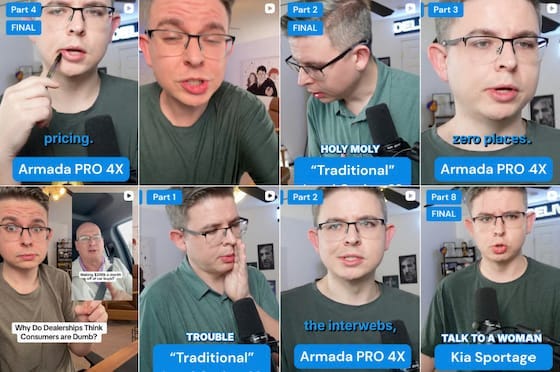
Charges $1,000 per car negotiation
Built credibility with ~50 free deals before charging
Now has a team of 5 negotiators
Works entirely remotely - all calls, no showroom visits
Uses competition: calls multiple dealers and makes them outbid each other
His breakthrough came from content:
Livestreamed negotiation calls → one hit 590K views
Built 600K+ followers across TikTok and YouTube
Now inbound leads — no outreach needed
The insight: People hate negotiating and will pay to avoid it.
This model can extend to:
Lease agreements
Contractor pricing
Medical bills
Insurance claims
Pick a domain you understand → do a few free wins → build proof → start charging premium.
You’re not selling effort. You’re selling confidence + savings.
$30K/month potential from an AI-generated podcast
Adam Levy built The Epstein Files, a fully AI-generated podcast that analyzes millions of pages of public documents and it exploded fast.
Built in a weekend, the show reached ~2M downloads in its first month and hit #1 on the UK podcast charts.
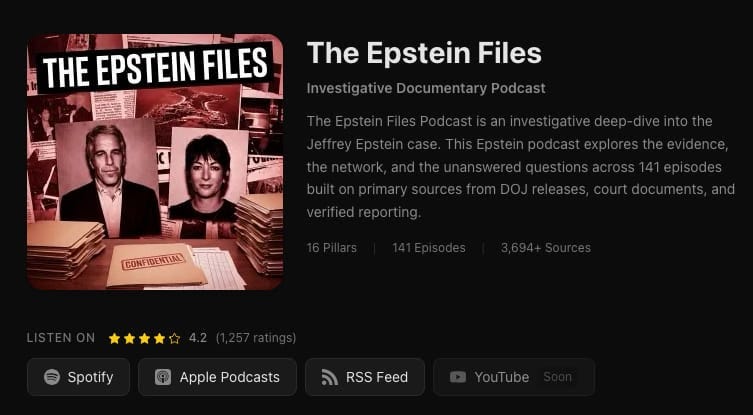
121 episodes in just 6 weeks (fully automated pipeline)
Uses multiple LLMs to connect names, timelines, and sources
Every claim links back to original DOJ documents
Runs on a simple setup - no studio, no team, no editing skills
Expanded into Spanish + new show (War Desk)
Revenue isn’t even turned on yet = but at standard podcast ad rates, 2M monthly downloads = $10K–$30K/month potential.
The real shift: One person can now run what used to require a newsroom.
Ideas to replicate:
Local politics or court cases
Startup funding + filings
Industry reports or earnings calls
Crime / investigation niches
Find a data-heavy niche → structure it → let AI generate consistent content.
Content production just got unbundled. Distribution is the real game now.
$1K/month selling simple Etsy printables (almost passive)
Chelsea Shelton started selling digital printables on Etsy during maternity leave - her first product was a basic spring cleaning checklist made in Canva. Within 5 days, she made her first sale.
Today, she has 700+ products and earns $1,000-$1,200/month, mostly on autopilot.
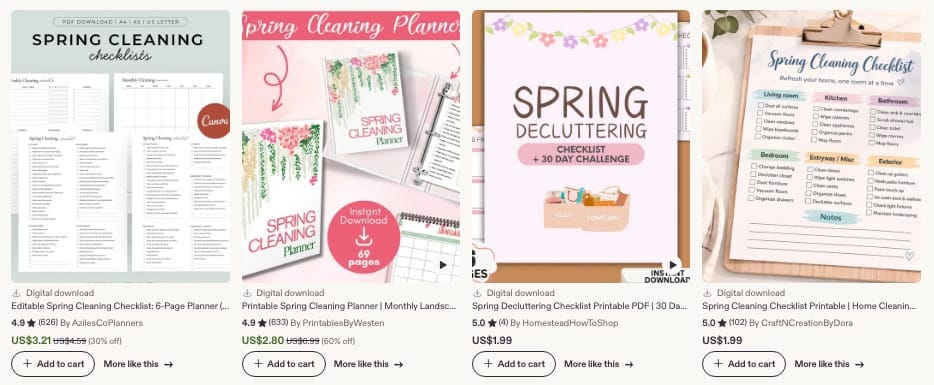
Products: checklists, planners, templates priced $1.50–$5
Higher pricing for editable/fillable versions
Also sells on Teachers Pay Teachers (25% of income)
Uses bundles (“buy 3, get 25% off”) to increase order value
Seasonal products bring recurring sales every year
What changed everything for her: She stopped making what she liked and started making what people were already searching for.
Her simple research playbook:
Use Etsy search autocomplete to find demand
Validate with tools like E-Rank or Everbee
Target keywords with 4K-6K searches and low competition
Niche down: “ADHD spring cleaning checklist” > generic versions
Som Most buyers don’t want to generate stuff with AI - they want something ready-to-use instantly. Create once → sell forever → repeat seasonally.
🤝 Partnership With US
Partner with us : Get your brand in front of 50000+ readers including founders, indie hackers, side hustlers and aspiring founders.
Thanks for reading today’s newsletter. Stay tuned for more!