


👋 Hi and welcome to today’s premium edition of Venture Radar - where we uncover boring businesses making real money, explore passive income opportunities, and break down ideas worth building.
Unlock 50+ founder playbooks & templates, a growing database of profitable business ideas and 2-3 premium deep dives every week
FROM OUR PARTNER - MECO
The best new app for newsletter reading - Meco

Reading newsletters in the inbox is frustrating - it is noisy and easy to lose control of subscriptions.
Now with Meco you can enjoy your newsletters in an app built for reading, while giving your inbox space to breathe.
Meco connects to Gmail & Outlook, allowing you to instantly move your newsletters to the app (and clear your inbox)
Partnership with us
Partner with us : Get your brand in front of 55000+ readers including founders, early builders, side hustlers and aspiring founders.
DEEP DIVE
Three brothers in Poland make $10M a year selling passport photos online. Here are 12 other things a bureaucracy will pay you to get right.
There is a company that makes $10 million a year from passport photos.
Not cameras. Not photo booths, though they started there. Passport photos. The small, boring, unsmiling square you need every ten years and dread every single time.
Here’s the whole product. You open an app. You take a selfie against a wall. Their software finds your face, straightens your head, swaps the background for the exact white your country demands, and crops it to the millimetre. Then a human looks at it, because the software is good but governments are picky. You get a digital file in minutes, or prints in the post.
That’s it. That’s the business.
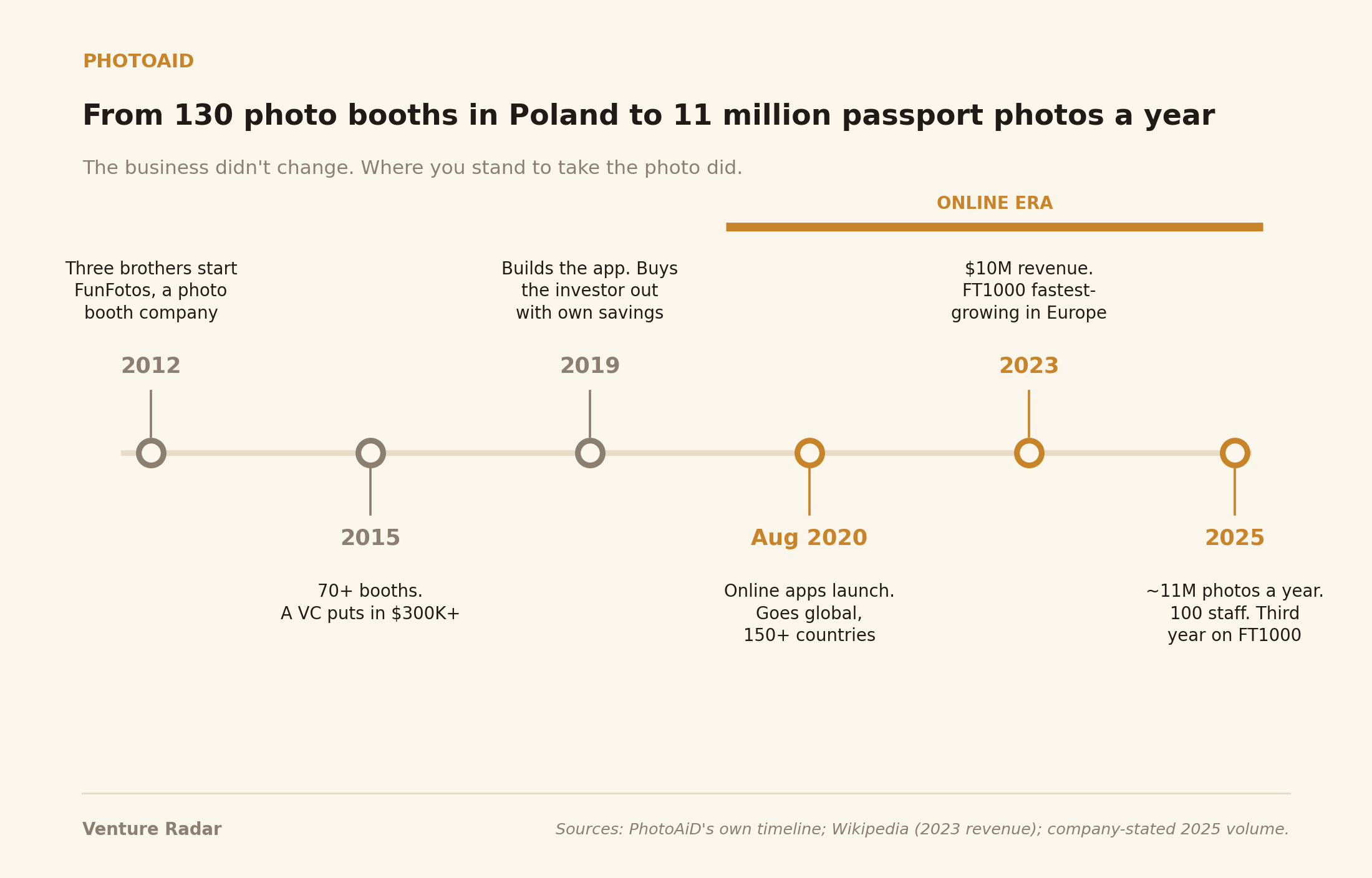
It’s called PhotoAiD, it’s run by three brothers from Poland, Tomasz, Marcin and Rafał Młodzki, and it did $10 million in revenue in 2023. They say they now take about 11 million passport and visa photos a year, which makes them the biggest passport photo service in the world. They’ve made the Financial Times list of Europe’s fastest-growing companies three years running. About 100 people work there.
Now, I’ll be honest about my first reaction, because you’re probably having it too. “That’s a feature. Any photo app can crop a square.”
Correct. Cropping a square is free. And yet here’s a $10 million business built on exactly that. So the money clearly isn’t in the cropping.
The money is in something much stranger.
There are over 150 countries in the world and almost every one has its own rules for what an acceptable ID photo looks like. Head size, eye position, background shade, file size, whether you can show teeth. The rules are public. They’re also scattered across hundreds of government websites, written in bureaucrat, and enforced by people who will put your application on hold for a shadow under your chin. The US State Department says unacceptable photos are the number one reason passport applications get put on hold.
PhotoAiD didn’t build a better camera. They built the one place that knows all the rules, checks your photo against them, and promises it’ll pass.
That pattern has nothing to do with photos. It’s sitting unexploited in a dozen other corners of every bureaucracy on earth.
We are going to cover:
Why did a photo booth company become an app company, and what happened when they bought their investor out?
The four tests for a “bureaucracy gap” business. The fourth one is what separates a $10M company from a free tool.
How you build the rules database that is the real product, and why AI makes it ten times cheaper than it was in 2020.
The pricing logic: why they charge per photo, not per month, and what the pharmacy down the street has to do with it.
12 bureaucracy gaps where the same model is open right now, plus 4 that look open but aren’t.
Where this breaks, including the uncomfortable fact that governments are starting to do this themselves.