


👋 Hi and welcome to today’s premium edition of Venture Radar - where we uncover boring businesses making real money, explore passive income opportunities, and break down ideas worth building.
Unlock 50+ founder playbooks & templates, a growing database of profitable business ideas and 2-3 premium deep dives every week
FROM OUR PARTNER - MECO
The best new app for newsletter reading - Meco
Reading newsletters in the inbox is frustrating - it is noisy and easy to lose control of subscriptions.
Now with Meco you can enjoy your newsletters in an app built for reading, while giving your inbox space to breathe.
Meco connects to Gmail & Outlook, allowing you to instantly move your newsletters to the app (and clear your inbox)
Partnership with us
Partner with us : Get your brand in front of 55000+ readers including founders, early builders, side hustlers and aspiring founders.
DEEP DIVE
A solo founder makes $350K a year from golf tournament software. Here are 12 other sports and hobbies still stuck with software everyone hates.
There is a guy who makes $30,000 to $40,000 a month from golf tournaments.
Not from playing in them, and not from running them. He sells the software that keeps score.
Here’s the whole product.
Golfers at a club tournament scan a QR code on their paper scorecard. They type in their scores. A leaderboard in the clubhouse updates live.
The pro shop prints the cart signs, the tee sheets and the bag tags off the same system. When it’s over, it works out who won the side games and how much everyone gets paid.
That’s it. That’s the business.
His name is Matt Robinson. About 150 golf courses pay him, and the software does roughly $350K a year in recurring revenue. He built it alone. No co-founder, no investors, no ads. For about four years he worked on it from 6 to 9 in the morning and on weekends, then went to his job as an engineer at Meta. In July 2026, a few days after Meta’s latest round of layoffs, he resigned. He wasn’t one of the people cut. The golf software had simply started paying him more than Meta was.
My first reaction was probably the same as yours: “There’s already software for this.”
There is. It’s called Golf Genius, it’s been around since 2009, and thousands of clubs use it. So Robinson isn’t building in an empty market. He’s taking customers away from a well-established company, one course at a time.
And here’s the part that made me look twice. He isn’t cheaper.
Golf Genius’s entry plan for tournament management is $1,300 a year plus a $200 setup fee. Robinson’s main plan is $2,700 a year. He’s charging roughly double and winning anyway.
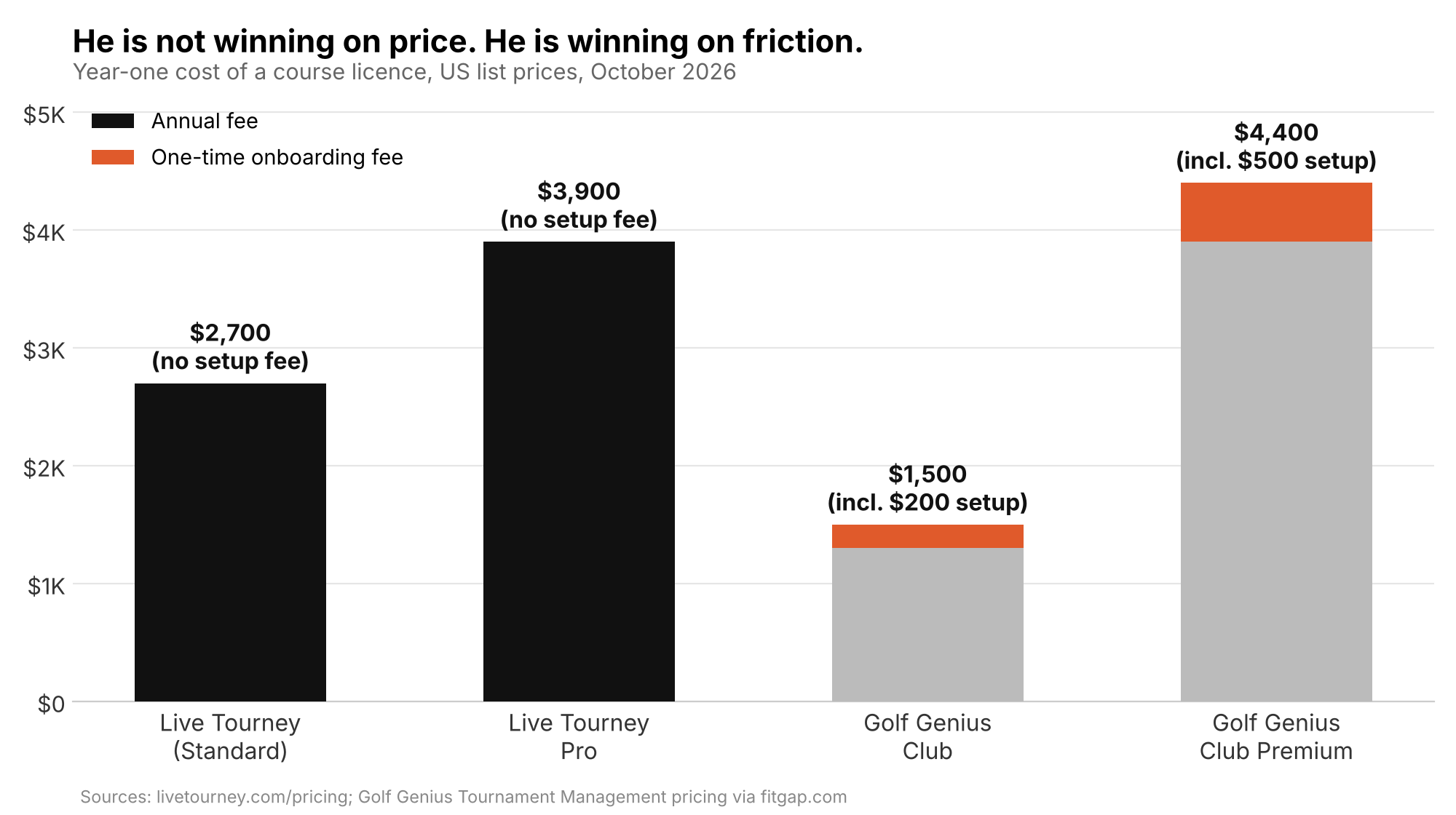
So he isn’t winning on price. He’s winning because golf pros can’t stand the tool they’ve been using, and he built the one they actually want to use on a Saturday morning.
That pattern has nothing to do with golf. It’s sitting in bowling alleys, dance studios, swim meets, fishing tournaments and dog shows. Anywhere a volunteer or a small-business owner has to run an event every weekend on software they quietly hate.
We are going to cover:
How one complaint from a club pro turned into 150 paying courses with no marketing, and why four years of 6am mornings mattered more than the idea.
The four tests for a “hated incumbent” business. The fourth is what lets you charge more than the company you’re replacing.
What the product actually has to do, and the one question that tells you what to build first.
The pricing logic: why he charges double, and what the $199 single-event plan is really for.
12 event-driven niches where the same gap looks open right now, plus 4 that look open but aren’t.
Where this breaks, including the maths on how hard it is to get from $350K to $1M.