


👋 Hi and welcome to today’s premium edition of Venture Radar - where we uncover real businesses making real money, explore passive income opportunities, and break down ideas worth building.
Unlock 50+ founder playbooks & templates, a growing database of profitable business ideas and 2-3 premium deep dives every week
FROM OUR PARTNER - MECO
The best new app for newsletter reading - Meco
Reading newsletters in the inbox is frustrating - it is noisy and easy to lose control of subscriptions.
Now with Meco you can enjoy your newsletters in an app built for reading, while giving your inbox space to breathe.
Meco connects to Gmail & Outlook, allowing you to instantly move your newsletters to the app (and clear your inbox)
Partnership With US
Partner with us : Get your brand in front of 55000+ readers including founders, indie hackers, operators and aspiring entrepreneurs.
DEEP DIVE
Every time a big app shuts down, millions of users need a new one. A solo founder made $10K a month catching them. Here are 7 dead apps with users still waiting.
In November 2023, Intuit announced it was shutting down Mint. If you’re not in the US you may never have used it, but for sixteen years Mint was the free budgeting app most Americans used to track their money. Millions of people had years of their financial history inside it.
The day of the announcement was the biggest signup day in the history of Copilot, a competing budgeting app. Copilot grew more in the next four months than in its previous four years combined. (TechCrunch)
But Copilot has investors. The one I care about is Lunch Money.
Lunch Money is a budgeting app built by one person, Jen Yip, with no funding and almost no marketing spend in five years. When Mint said it was closing, it’s daily signups went up more than five times and stayed there for weeks. Churn didn’t move. She added over $10,000 in monthly recurring revenue, and at one point had to pause new registrations and run a waitlist because she couldn’t keep up. She’s now at around $34K MRR.
She did not do anything clever that week. She was simply standing there, with a working product, when a few million people went looking for one.
Now the uglier version of the same story.
Omegle, the random video chat site, closed on 8 November 2023 with no notice. It had been running for fourteen years. In February 2026, more than two years later, someone launched a site called OmegleWeb. By late October it was doing $73,000 a month in subscriptions, with 2,317 paying users, verified through Stripe. The founder is anonymous. I wouldn’t build that business, and I’ll say why later. But the point stands: a dead site’s search traffic didn’t die with it. It sat there for two years waiting for anyone to catch it.
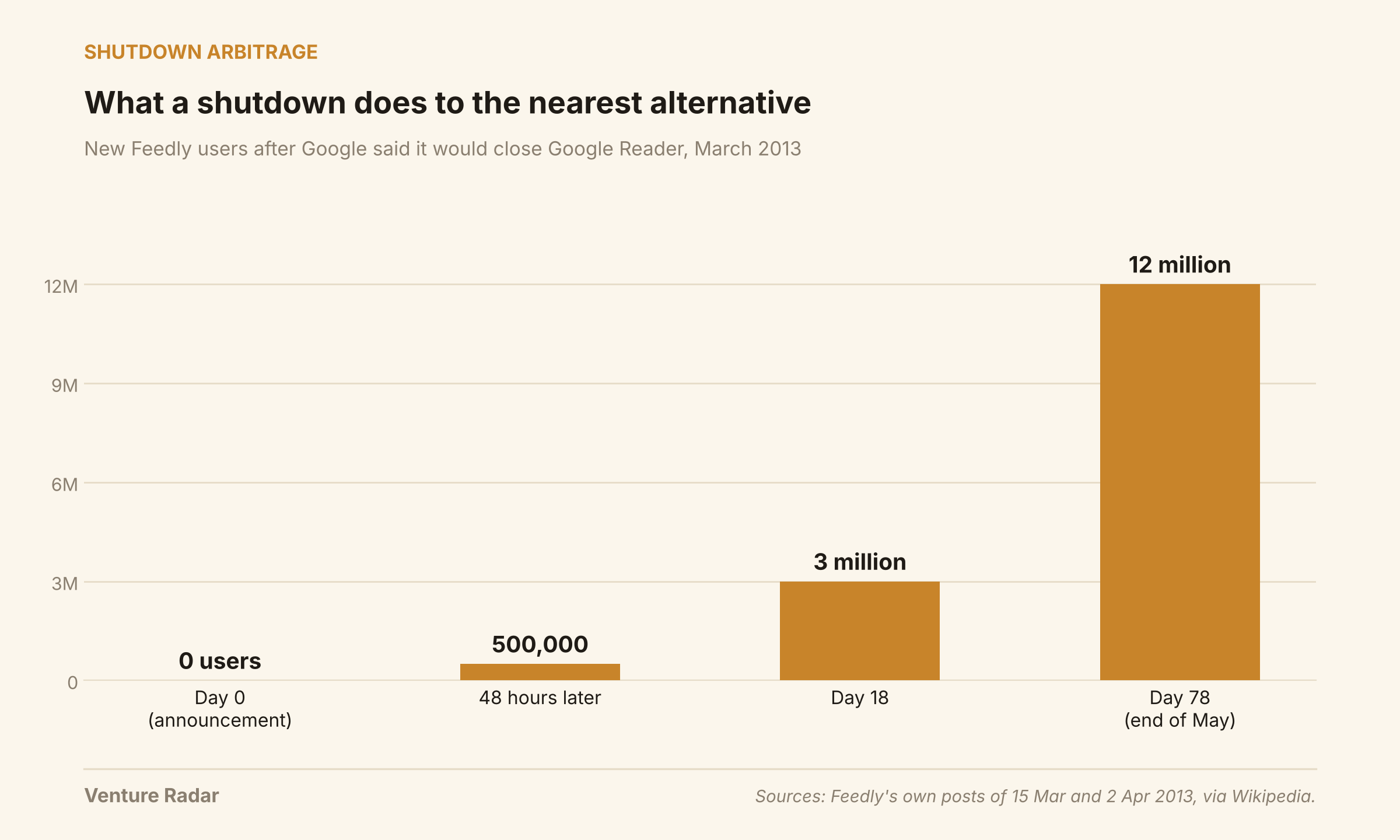
This isn’t new. When Google said in March 2013 that it would close Google Reader, a small RSS app called Feedly picked up 500,000 new users in 48 hours, 3 million in 18 days, and 12 million by the end of May. (Wikipedia, citing Feedly’s own posts) Feedly had existed for five years before that. Nobody cared until Google quit.
Here’s what I think most founders get wrong about this.
They see a shutdown as a loss. A product they used is gone. What it actually is, every single time, is a few hundred thousand people with a habit, a budget and a problem, who have just been told by the company they trusted to go find somebody else. There is no cheaper customer on the internet than one who has already been told to leave.
And shutdowns are not rare. Big companies kill products every month. Most of those deaths leave behind a search query nobody’s answering.
We are going to cover:
Why the notice period is the whole game, and what Mint’s 142 days versus Omegle’s zero tells you about how to time it.
The five questions that separate a shutdown worth chasing from one that’s a trap. Two of them would have kept you away from Omegle.
Where to look every week to find shutdowns before the press writes about them, including the three signals that come months before any announcement.
What to actually build in the window: the one feature that matters, the import tool, and why “alternative to” is the only SEO you need.
Seven shutdowns from the last two years where the gap is still open, plus four where it isn’t.
Where this breaks, including the thing that happened to Feedly a year later.