


👋 Hi and welcome to today’s premium edition of Venture Radar - where we uncover real businesses making real money, explore passive income opportunities, and break down ideas worth building.
Unlock 50+ founder playbooks & templates, a growing database of profitable business ideas and 2-3 premium deep dives every week
The $2M/year quiz site nobody brags about (and the exact system to build your own)
There is a guy named Bryce Welker.
He passed the CPA exam. Then he did something most people never think to do. He built a website that helps other people pass it too. Then another for the LSAT. Then the PMP. Then securities exams, trades exams, project management exams. Over 20 of them.
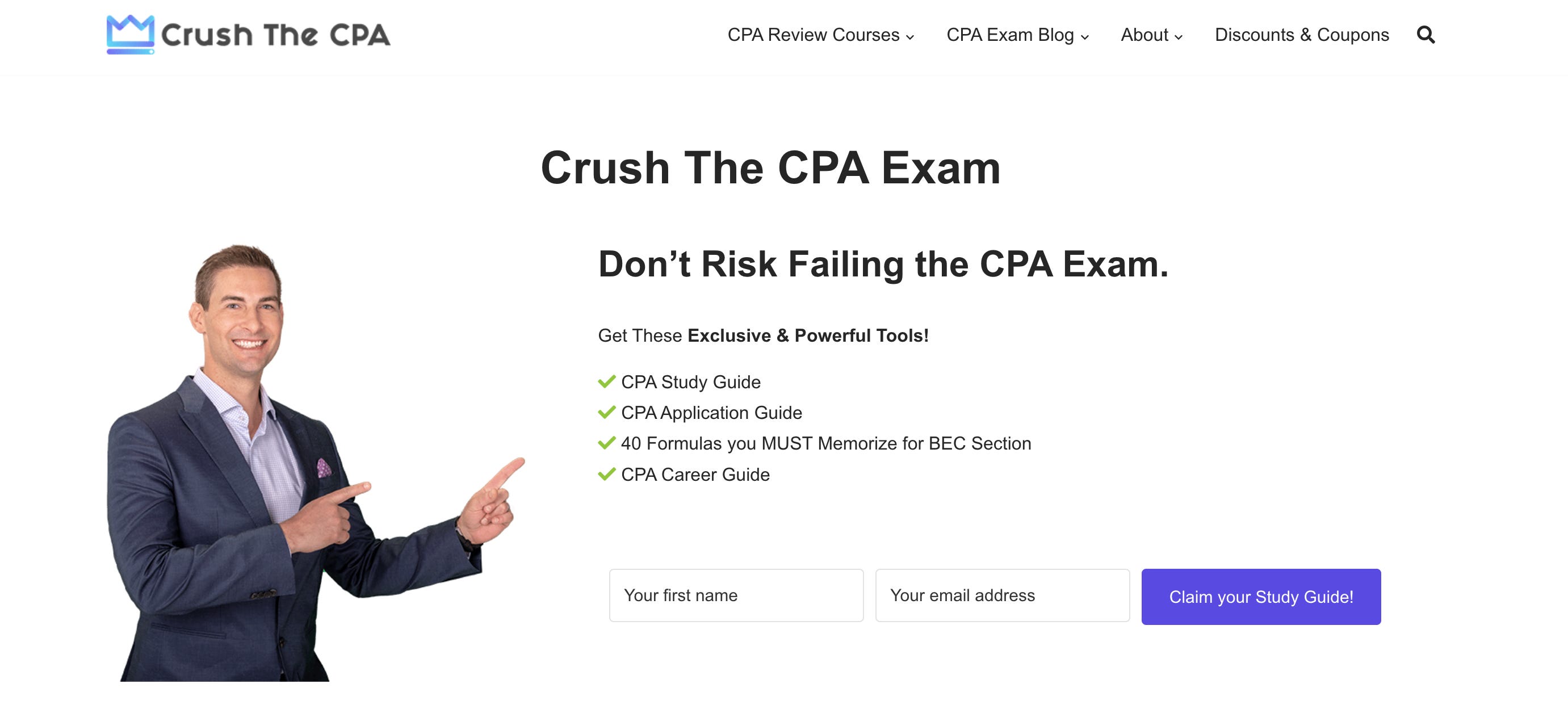
He bootstrapped it from Thailand with no outside money. In a 2017 interview he said the network had gone from $1,000 a month to roughly $2 million a year, with about 95% of customers coming from search. No ads. No viral TikTok. Just people typing “best CPA review course” into Google at 11pm in a panic.
That is the whole business.
Help people pass a test they are legally required to pass.
It is one of the most boring, most copyable, most ignored online businesses on the internet. And almost nobody in your feed is building one, because nobody brags about owning a forklift-certification quiz site at a dinner party.
That is exactly why it works.
Every mandatory exam is a tollbooth
Here is the mental model. Forget “education.” Think tollbooth.
A law, an employer, or a licensing board says: you cannot do this job until you pass this exam.
The person on the other side of that exam is not curious. They are not a casual learner. They are scared, motivated, and on a deadline. Their salary, their license, their visa, or their promotion is sitting on the other side of a passing score.
That is the best customer on the internet.
High intent. High stakes. Willing to pay. And the exam creates the demand for you. You do not have to convince anyone they have a problem. The state already did that.
This is not a US-only game either. Nursing candidates in the Philippines and India sit the NCLEX to work in America. The UK, Canada, and Australia each run their own licensing regimes for nurses, accountants, electricians, and real estate agents. IELTS and PTE gate immigration worldwide.
Every country has its own wall of exams, and every wall has people standing in front of it looking for help.
How big is this, actually
Estimates vary a lot depending on how you draw the lines, so treat these as directional, not gospel.
One widely cited estimate from Global Industry Analysts pegs the global test preparation market at about $126 billion in 2024, with the US alone around $37.6 billion, growing toward $178 billion by 2030. A broader “exam prep and tutoring” figure from The Business Research Company sits near $70 billion in 2025. Certification and professional exams are one of the largest and fastest-growing slices inside all of it.
You do not need a slice of $126 billion. You need a slice of one exam.
A single niche cert doing low five figures a month, run by one person, is a life-changing business and a rounding error to the market.
There are hundreds of these exams. Most have weak, ugly, outdated incumbents.
A few people quietly doing this
Short version. Just the numbers and the niche.
Bryce Welker, Crush Empire.
20+ test-prep and review sites (CPA, LSAT, PMP, securities, trades). Reported $1K/month to roughly $2M/year, bootstrapped, ~95% of customers from SEO.
Peter Murphy and Ken Gillette started it with about $1,800 because Murphy needed to pass his own CPIM certification. Built the questions first, the platform second. Grew to 5M+ downloads and an Inc. 5000 spot, entirely through organic growth and subject-matter-expert content partnerships, across nursing, EMT, trades, IT, and finance certs.
Four Berkeley MBA students, about $2K each, no real outside funding. Started as GMAT practice questions they wrote themselves while studying for the GMAT. Sold access at $29/month. Now an estimated $3.9M/year (getLatka estimate), serving GRE, GMAT, SAT, and more.
Michael Gardon built it starting in 2017. In January 2025 he sold it to Bryce Welker’s Crush Empire. Proof these things are not just income. They are assets people buy.
Different exams. Different models. Same engine: a forced test, a scared customer, and content that helps them pass.
Here is the part nobody hands you:
The 6-filter scorecard, fully explained. How to score any exam in 10 minutes and kill bad niches before you waste a month on them.
The recurring-revenue trick. The one exam feature that turns a single sale into income that comes back every renewal cycle, for years.
How to build the content even if you never passed the exam. The exact two types of people to partner with, where to find them, and three ways to structure the deal (from $0 upfront).
The marketing playbook that quietly prints. The free-question funnel, the keywords to target, and how operators pull 95% of customers from Google with zero ad spend.
How to price it. One-time vs subscription vs affiliate, real price anchors, and the one add-on that lifted a real operator’s revenue 35%.
The 5 ways this business kills you. The Google update, the exam change, the wrong-answer landmine, and how to survive all three.
The exit. What these sites sell for, and where people buy and sell them.
Why the money keeps coming back
A one-time exam is a fine business. A recurring exam is a great one.
Look for exams that do not end when someone passes. Many professional certifications expire. PMP holders need 60 professional development units every three years. CompTIA certs lapse after three years. Nurses, accountants, electricians, real estate agents, and insurance brokers in most regions owe continuing education (CE) hours to keep their license active.
That means the same customer comes back. Pass the exam, then buy CE credits every renewal cycle, forever. You are not selling one ticket. You are selling a season pass to a career.
When you evaluate a niche, the recertification question is the single biggest multiplier on lifetime value. Prioritize it.
How to pick the niche (this is the strategy, not a dartboard)
Do not pick the exam you like. Pick the exam that scores well on six things. Run every candidate through this. If it fails two or more, walk away.
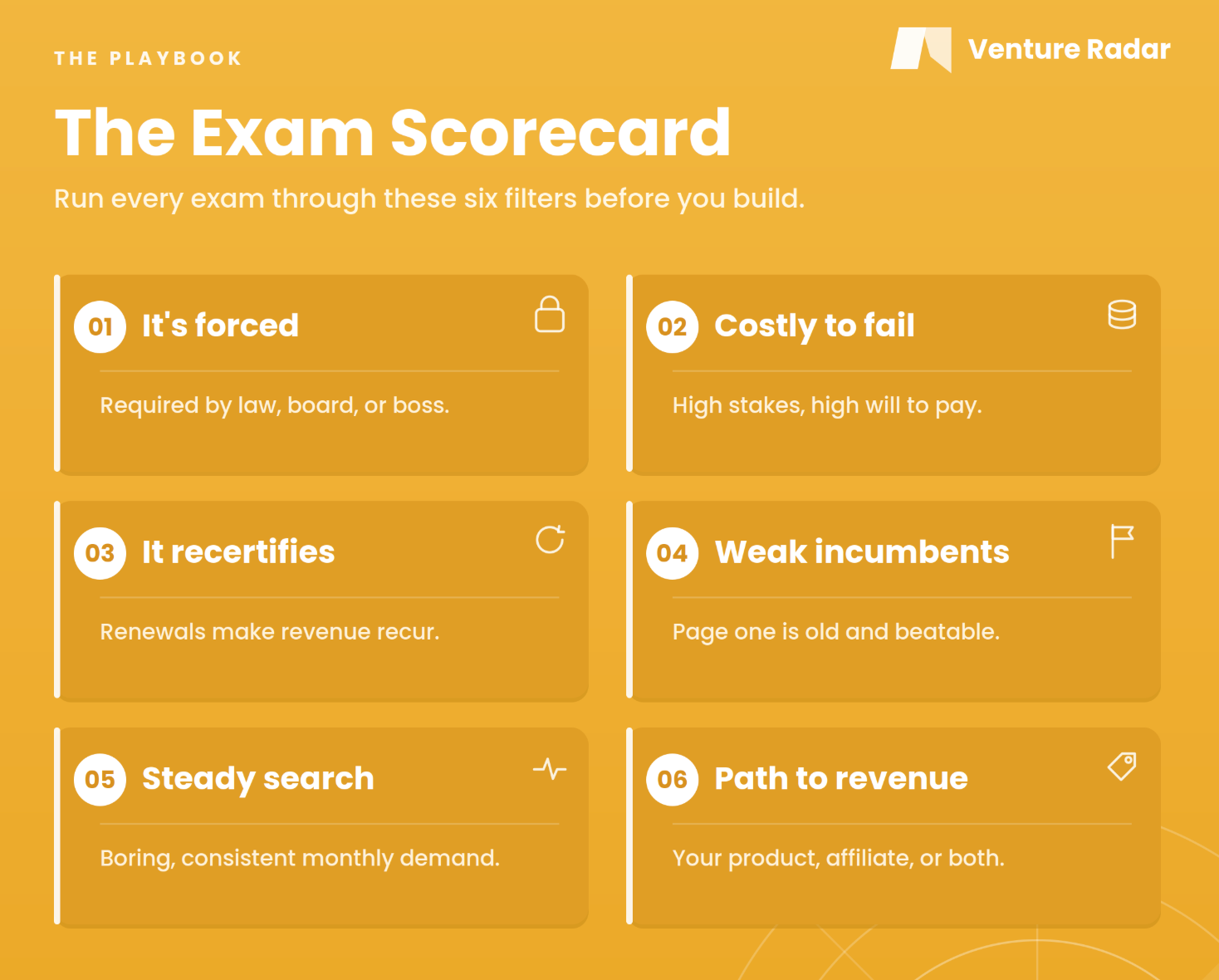
It is forced. A law, board, or employer requires it. No “nice to have” exams. The requirement is your marketing department.
Failing is expensive. A high exam fee, a blocked salary, a delayed license, a lost job offer. The more it costs to fail, the more people pay to pass. A $50 quiz that protects a $70,000 starting salary sells itself.
It recertifies. CE hours or expiry, per the section above. Recurring beats one-time every time.
The incumbents are weak. Google the exam plus “practice test” and “study guide.” If page one is a clunky 2009-era site, a dead forum, and an overpriced official prep book, you found your opening. If page one is three slick venture-backed apps, pick a different exam.
There is real search volume, but not too much. You want consistent monthly searches, not a viral spike. Boring and steady is the goal. Use a keyword tool to confirm people actually look for help with this exam every single month.
There is a way to get paid. Either you sell your own product, or there are existing prep courses with affiliate programs you can rank above and refer to. Ideally both.
The sweet spot is an unglamorous professional or trade license.
Think medical billing, HVAC, pharmacy tech, real estate, insurance licensing, food safety manager, commercial driving, IT security certs. Nobody is fighting you for the keyword “ServSafe practice test.”
Everybody who needs it is desperate.
You do not need to have passed the exam
This is the unlock most people miss. You are not the product. The content is. And you can source the content from people who already cracked it.
There are two ways in, and you mentioned both. They map to two kinds of partners.
Path A: You passed it.
Easiest start. You have the credential, the war stories, and the trust. You write the first version yourself, like Pocket Prep and Magoosh did. Your own pass is your unfair advantage and your marketing story.
Path B: You did not pass it, so you partner with someone who did.
This is how Bryce Welker covers law, project management, and securities exams he never sat. It is how Pocket Prep scaled across dozens of certs: they grew through subject-matter-expert content partnerships. You bring the building, the SEO, the funnel, the operations. Your partner brings the credibility and the questions.
Where to find these partners, concretely:
Recent passers. People who passed the exam in the last 6 to 12 months remember exactly what was hard and what the official prep missed. They are gold and they are cheap. Find them in exam subreddits, Facebook study groups, Discord servers, and “I passed!” LinkedIn posts. Message the ones who wrote helpful breakdowns.
Working professionals with the cert. For recertification and advanced content, the veteran who has held the license for a decade. Find them on LinkedIn by filtering for the credential.
Instructors and tutors already teaching the exam who want passive income instead of hourly grind.
How to structure the deal, from lightest to heaviest commitment:
Pay per question. Flat fee for a vetted bank of questions and explanations. Clean, simple, you own the content.
Revenue share. They write and maintain content, you split a percentage of revenue. Aligns incentives, no upfront cash.
Equity or co-founder. Only if they are bringing an audience or doing real ongoing work. Most of the time you do not need to give this away.
[DROP IN: Founder 1 interview.] Two to four short lines on how they sourced their content and structured the partnership. Real quote, real numbers if they will share them. Keep it punchy.
[DROP IN: Founder 2 interview.] Their take on niche selection or the moment the SEO started compounding. One concrete story beats a paragraph of theory.
A note on integrity, because it matters here: do not fake the credential. If experts wrote your content, say so. If you have a pass guarantee, honor it. Trust is the entire moat in a business where someone’s career is on the line.
Marketing: it is SEO, and it is not close
Every operator in this edition runs on the same engine. Bryce Welker: ~95% of customers from search. Pocket Prep: 100% organic growth. This is not a coincidence. It is the model.
Why SEO wins here: the customer is searching with raw intent. “NCLEX practice questions free.” “PMP exam how many questions.” “ServSafe practice test 2026.” They are not browsing. They are hunting for the exact thing you sell. You just need to be the result they find.
The playbook:
Build the free funnel. Put a generous free practice test or question bank on the page. It ranks, it builds trust, and it warms the buyer. Then upsell the full bank, the timed mock exams, the explanations, the pass guarantee. Free questions are the hook. The complete prep is the product.
Cover the whole question universe. Every sub-topic, every “how hard is X exam,” every “X exam pass rate,” every “best X study guide.” Each is a page. Each catches a searcher at a different moment of panic.
Use the recent-passer loop for content and proof. The same people who write your questions write your testimonials. “I used this and passed on my first try” is the only ad that works here.
Go where they panic together. Exam subreddits, study Discords, Facebook groups. Be genuinely helpful, link when it actually helps. One pinned answer in an active forum can send buyers for years.
App stores are their own search engine. Pocket Prep grew on mobile. People literally search the App Store for “[exam name] prep.” A simple, well-reviewed app is a second front door.
How to charge
You have three revenue models. The best businesses stack them.
One-time digital product.
Sell the question bank, the study guide, the mock exams as a one-off. Magoosh-style prep historically ran in the $130 to $150 range, a fraction of a classroom course. Easy to start, easy to sell on Gumroad or your own site. Weakness: you resell to each customer only once.
Subscription.
Charge monthly or for a fixed access window (say 1, 3, or 6 months of access). Magoosh opened at $29/month. This fits exams with long study cycles and pairs perfectly with recertification, because the customer comes back every renewal. This is where the durable money is.
Affiliate.
Rank for the buying keywords, review the big prep courses, refer the sale, take a commission. This is Bryce Welker’s core model. Near-zero product cost. You are a high-intent referral machine. Weakness: you do not own the customer, and you live on someone else’s payout terms.
Two levers to charge more:
The pass guarantee. Pocket Prep added one and saw a roughly 35% revenue increase. It crushes the buyer’s last objection. You can afford it because most people who actually use good prep do pass.
Bundle the recert. Sell the exam prep once, then the CE credits on a subscription. Same customer, repeat revenue, higher lifetime value.
Now the honest part: how this business kills you
This is where free content stops and we tell you the truth.
Google is your landlord and your executioner.
When ~95% of your traffic is organic, one algorithm update can cut your revenue in half overnight. Diversify early. Build an email list of every free-test taker. Build an app. Build a forum. Own an audience Google cannot take.
The exam changes and your content rots.
Licensing boards revise exams. When the format or syllabus changes, your question bank is suddenly wrong, and wrong is fatal in this niche. You must monitor the official board and update fast. This is ongoing work, not a set-and-forget asset.
Wrong answers destroy you.
One viral “this site’s answers are outdated, I failed because of them” post can end the business. Quality control is not optional. This is why you vet every expert and date every update.
Single-exam concentration is fragile.
One exam, one Google ranking, one board. That is three single points of failure stacked on top of each other. The operators who last build a portfolio, the way Welker runs 20+ sites and Pocket Prep covers dozens of certs.
Affiliate-only means you are a guest.
If you never sell your own product, the prep company can cut commissions or kill the program. Own something.
None of this is a reason not to start. It is the difference between a business that lasts and a project that gets wiped in 18 months.
These businesses sell
Worth saying again, because it changes how you think about the work. Testing.org sold to Crush Empire. Content sites with steady organic traffic and recurring revenue trade as real assets on marketplaces like Acquire.com, Flippa, and Empire Flippers. You can build to flip, not just to run. Boring, profitable, and durable is exactly what acquirers pay multiples for.
Tools to actually build it
You do not need a developer to start.
QBank.com lets a content expert build a question bank and sell subscription access on their store. Purpose-built for exactly this.
ClassMarker does online exams, question banks, timers, randomization, and branded certificates, on subscription or pay-as-you-go.
Teachable, Podia, or Gumroad to sell courses and digital downloads with a paywall.
No-code (Bubble, Glide, Softr) if you want a custom quiz app without engineering.
A keyword tool (Ahrefs, Semrush, or the free Google Keyword Planner) to confirm search demand before you write a single question. Do this first.
Your first-week checklist
List 10 exams you or someone you know has passed.
Score each on the six criteria. Forced, expensive to fail, recertifies, weak incumbents, steady search, a way to get paid.
Pick the one with the weakest page-one competition and real monthly search volume.
If you passed it, write 50 questions this week. If you did not, message three recent passers and offer a per-question or rev-share deal.
Put 20 questions free on a simple page, gate the other 30, and start covering the long-tail keywords one page at a time.
Pick the boring exam. Help the scared person pass it. Get found on Google. Charge for the thing that protects their career.
That is the business. Go build the tollbooth.
Unlock 50+ founder playbooks & templates, a growing database of profitable business ideas and 2-3 premium deep dives every week.
Partnership With US
Partner with us : Get your brand in front of 50000+ readers including founders, indie hackers, side hustlers and aspiring founders.