


👋 Hi and welcome to today’s premium edition of Venture Radar - where we uncover real businesses making real money, explore passive income opportunities, and break down ideas worth building.
Unlock 50+ founder playbooks & templates, a growing database of profitable business ideas and 2-3 premium deep dives every week
The $70 billion business nobody wants to think about: helping families handle life after death.
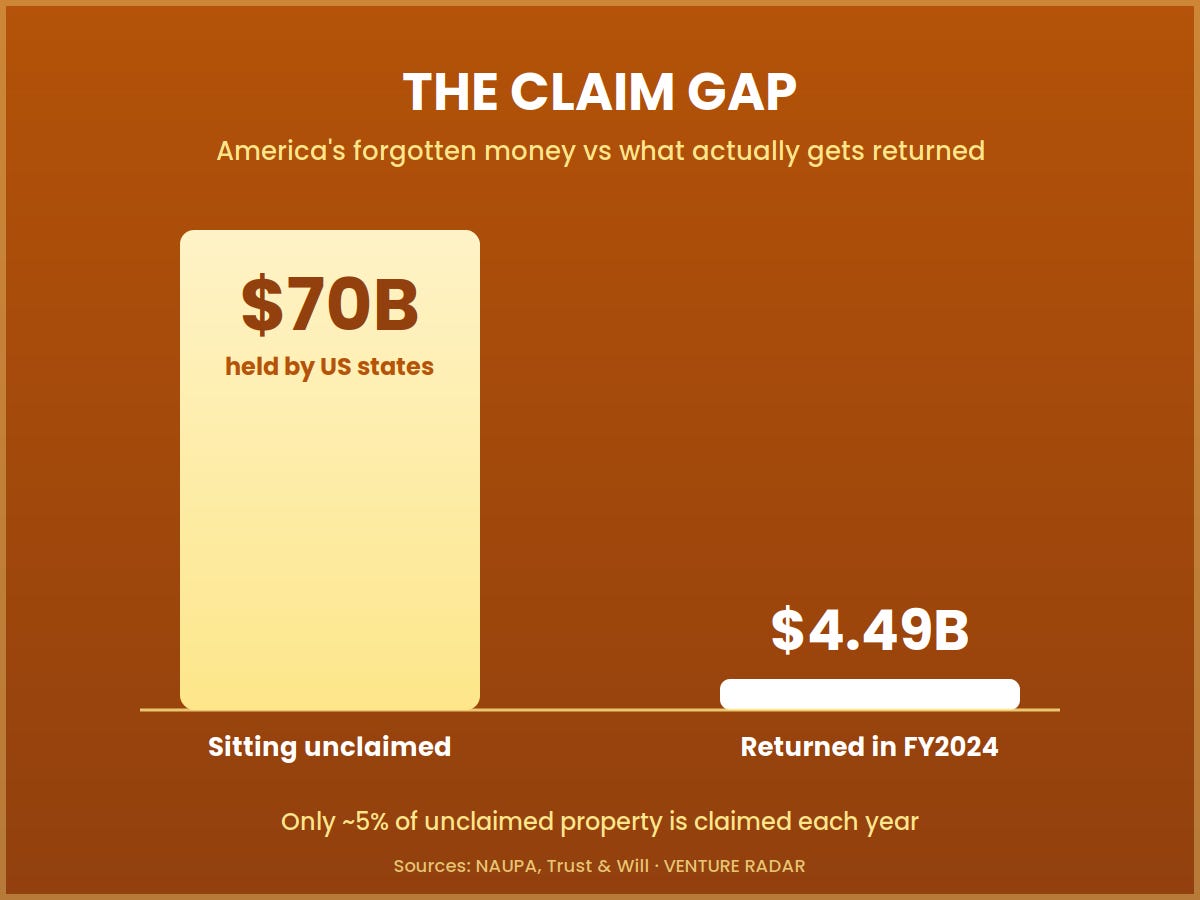
There is $70 billion sitting in US government vaults right now that belongs to regular families.
Not tax money. Not government funds. Forgotten bank accounts. Uncashed paychecks. Life insurance payouts that never found their beneficiary. Stock certificates from a grandfather who died in 2004.
States are holding over $70 billion in unclaimed property owed to roughly 33 million Americans. That is one in seven people. And only about 5% of it gets claimed each year.
Why does so much money just sit there?
Because most of it belongs to dead people. And their families have no idea it exists.
Here is what actually happens when someone dies.
The funeral gets handled. Everyone knows funerals are a business. But after the funeral comes the part nobody talks about: 40 to 80 accounts to close, transfer, or claim. Banks. Insurance. Pensions. Subscriptions. Utilities. Social media. Property papers. Tax filings.
Research from Empathy, the biggest startup in this space, found that the average family spends $12,616 and takes 13 to 15 months to finish the admin after a death. Some families burn up to 500 hours on paperwork. While grieving.
That gap between “overwhelmed family” and “mountain of admin plus forgotten money” is a real business.
Multiple businesses, actually. VCs have noticed: Empathy has raised $162 million to attack this in the US. But here is the part that matters for you: the models underneath are simple, capital-light, and copyable by one person.
We spent this week reverse-engineering how the real operators in this space run their businesses. Empathy in the US. Settld in the UK. Share Samadhan in India. Plus the small independent operators making a living from state unclaimed property databases. What follows is the playbook we pieced together from how they actually operate: the models, the pricing, the validation steps, and the traps.
In this edition:
How big this market really is (US, UK, Europe, India)
The four business models, ranked by how fast you can start
The money model: what operators actually charge
How to validate demand before building anything
How to pick your lane and get your first 5 clients
What it costs to run (tools, hiring, time)
The honest downsides nobody mentions
Your first 90 days
Let’s get into it.